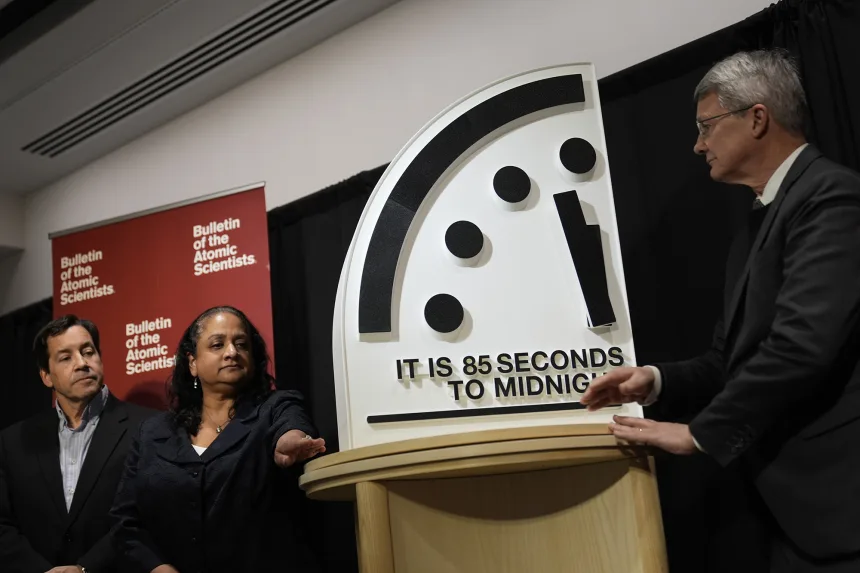
The Doomsday Clock has been moved closer to midnight than ever before, signaling what scientists describe as an unprecedented level of danger facing humanity. In its 2026 update, the Bulletin of the Atomic Scientists set the clock at 85 seconds to midnight, the closest it has been since the symbolic timepiece was created in 1947.
Midnight represents a point at which Earth becomes uninhabitable due to human-made catastrophes. The latest adjustment reflects mounting concerns over nuclear conflict, climate change, biological threats, and the rapid, largely unregulated expansion of artificial intelligence.
According to the Bulletin, the decision to move the clock forward was driven by a lack of meaningful progress in addressing these interconnected risks. While last year’s setting of 89 seconds to midnight already marked a historic warning, scientists argue that global conditions have continued to deteriorate rather than improve.
Nuclear tensions and geopolitical instability
One of the most pressing concerns remains nuclear weapons. Scientists pointed to escalating conflicts involving nuclear-armed states and a breakdown in international cooperation. Of particular alarm is the imminent expiration of the last remaining treaty limiting nuclear arsenals between the United States and Russia. Once it expires, there will be no formal constraints preventing a renewed nuclear arms race for the first time in decades.
Experts warn that rising nationalism and aggressive military posturing have replaced the diplomacy that once helped reduce nuclear threats during the late Cold War. The Bulletin noted that instead of de-escalation, major powers have become more adversarial, increasing the risk of miscalculation or unintended conflict.
Climate crisis and biological threats
Climate change continues to be a central factor in the clock’s calculation. Despite years of warnings from scientists, global emissions remain high, extreme weather events are becoming more frequent, and coordinated international action has fallen short of what is needed to prevent irreversible damage.
At the same time, advances in the life sciences present new dangers. Researchers expressed concern over emerging technologies such as synthetic and “mirror” life, warning that the world lacks a coordinated plan to manage potential biological risks. The experience of recent pandemics, they argue, has not translated into adequate global preparedness for future threats.
Artificial intelligence and misinformation
For the first time, artificial intelligence has emerged as one of the most significant contributors to the clock’s movement. Scientists warned that the rapid spread of AI tools, combined with weak oversight, is amplifying misinformation and disinformation on a global scale. This erosion of shared facts, they say, undermines public trust, weakens democratic institutions, and makes collective action on existential risks far more difficult.
AI’s role extends beyond information warfare. Its growing use in military systems, surveillance, and decision-making processes raises concerns about accountability and unintended consequences, especially in high-stakes environments such as conflict zones.
A warning, not a prediction
The Bulletin emphasizes that the Doomsday Clock is not a precise measure of how or when catastrophe will occur. Instead, it is meant to serve as a warning and a conversation starter — a way to communicate the urgency of the moment in a form the public can easily grasp.
Critics have described the clock as an imperfect metaphor, noting that it combines different types of risks that unfold on varying timelines. Still, many scientists argue that its power lies in its symbolism. As one expert put it, the shift from minutes to seconds reflects a sobering reality: the margin for error is shrinking.
Can the clock be turned back?
History shows that progress is possible. In 1991, the clock was set back to 17 minutes to midnight following major arms reduction agreements between the United States and the Soviet Union. The Bulletin argues that similar bold, cooperative actions are still achievable today.
Scientists stress that responsibility does not rest solely with world leaders. Public engagement, informed discussion, and resistance to misinformation are seen as critical steps in pushing governments toward action. On an individual level, choices that reduce environmental impact and support credible information sources can also contribute, even if incrementally.
Ultimately, the 2026 Doomsday Clock update delivers a stark message: humanity is running out of time, but the future is not yet sealed. The same technologies and systems that created today’s dangers could still be redirected toward solutions — if the global community chooses to act before the clock reaches midnight.
Check out our latest article: Shedeur Sanders to Make Pro Bowl as Rookie, Outshining Dad